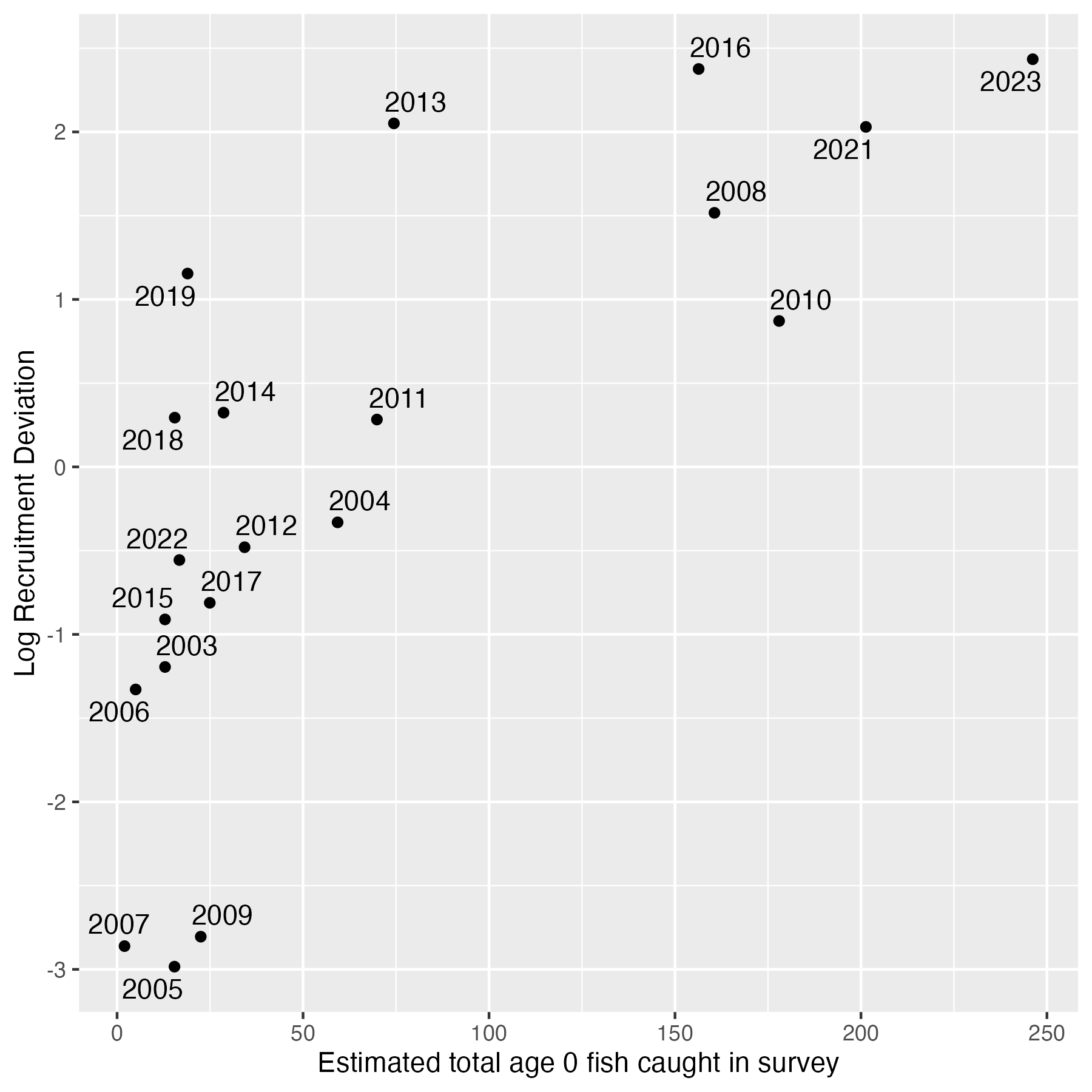
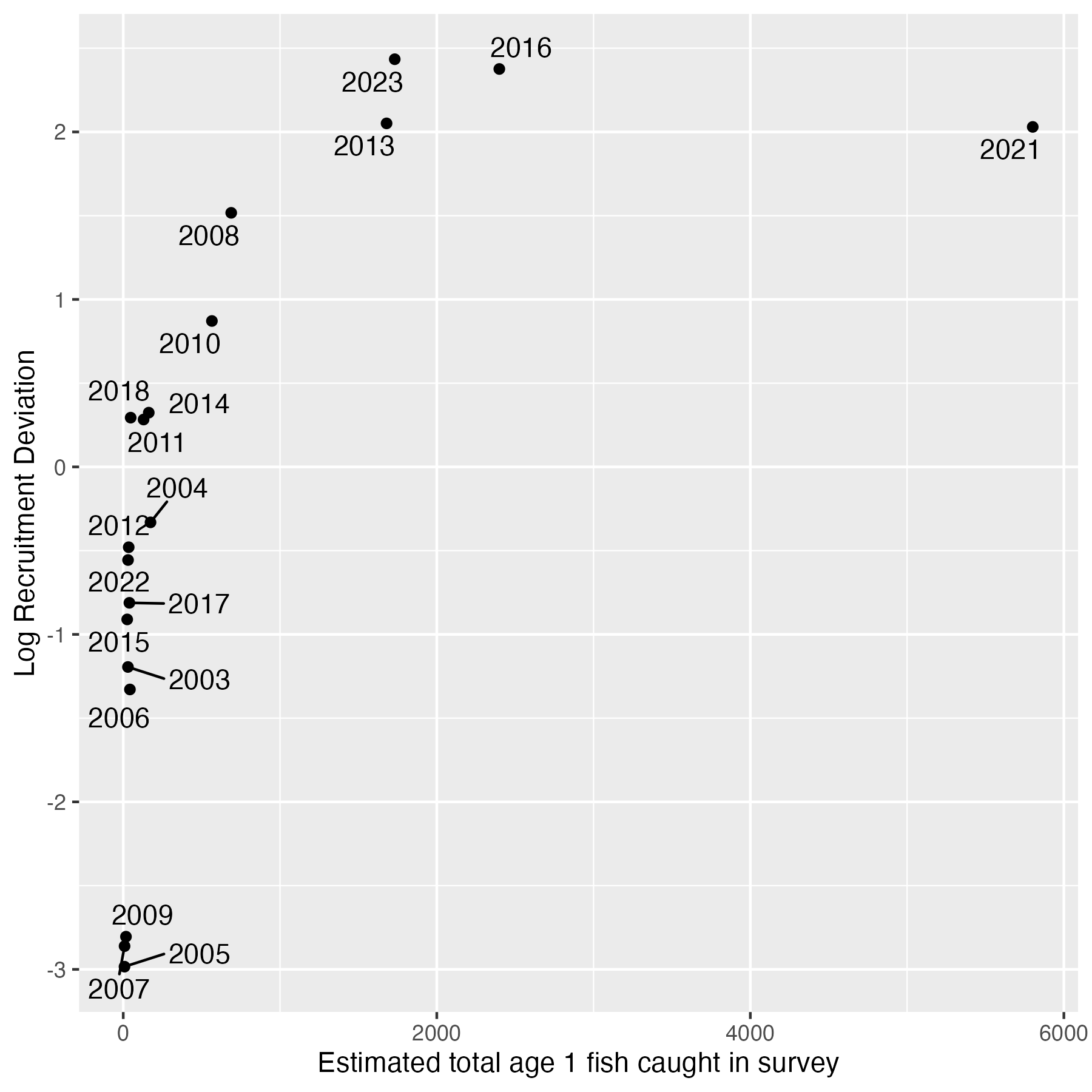
The juvenile stages of some stocks are well surveyed by the West Coast Groundfish Bottom Trawl Survey. Here, I show a number of different age and length classes for Sablefish caught in the survey, as well as the correlation between the age-0 and age-1 fish caught in the survey and the recruitment estimates from the stock assessment. For the age and length compositions, I show the estimated fish of each age and length class in the survey, based on the extrapolation of the age and length sub-samples of each tow to the full number of fish caught in that tow. Note that this has typically been 20 lengths per tow and 4 ages per tow, and therefore the extrapolation is based on a much larger sample size for lengths.

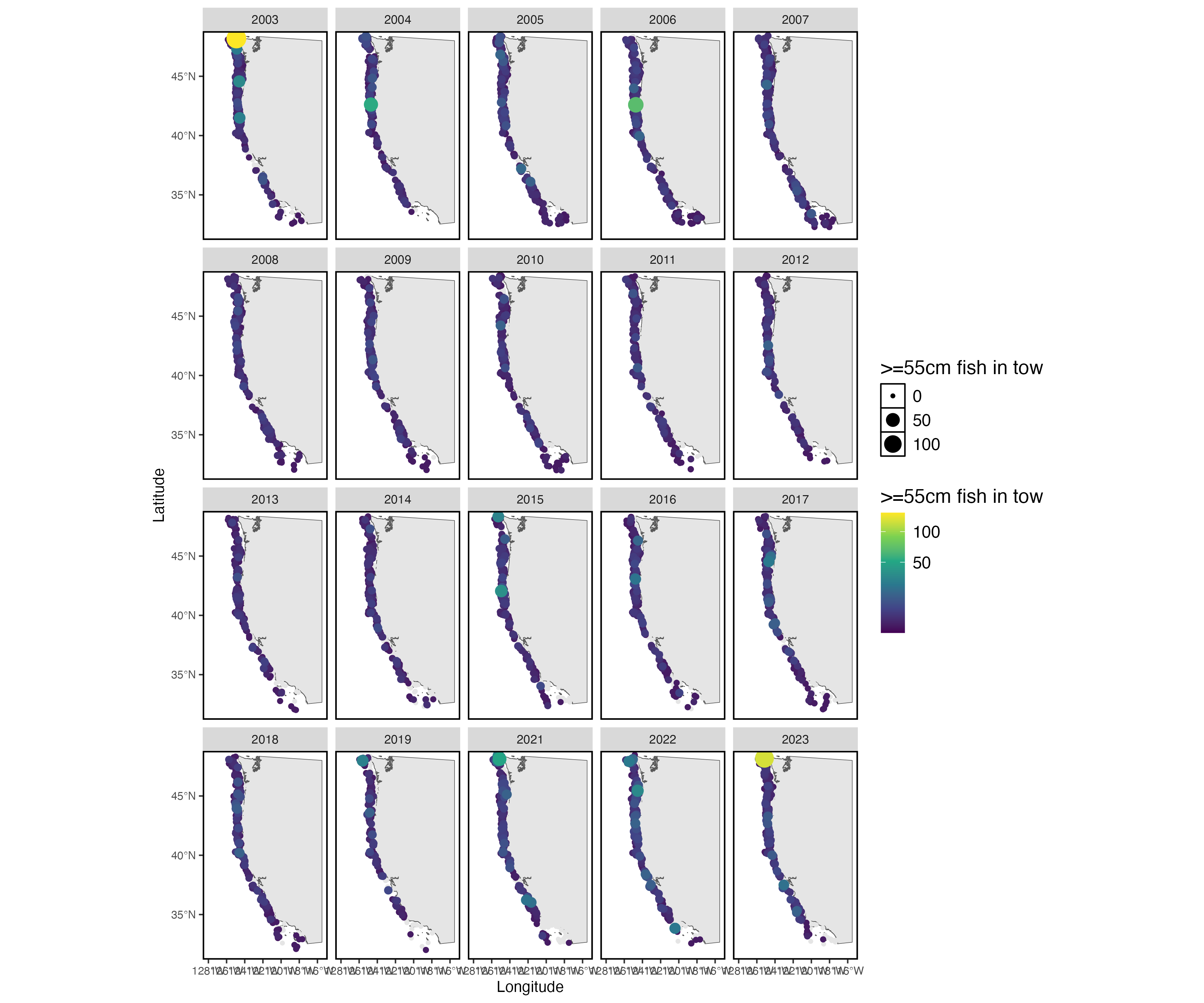
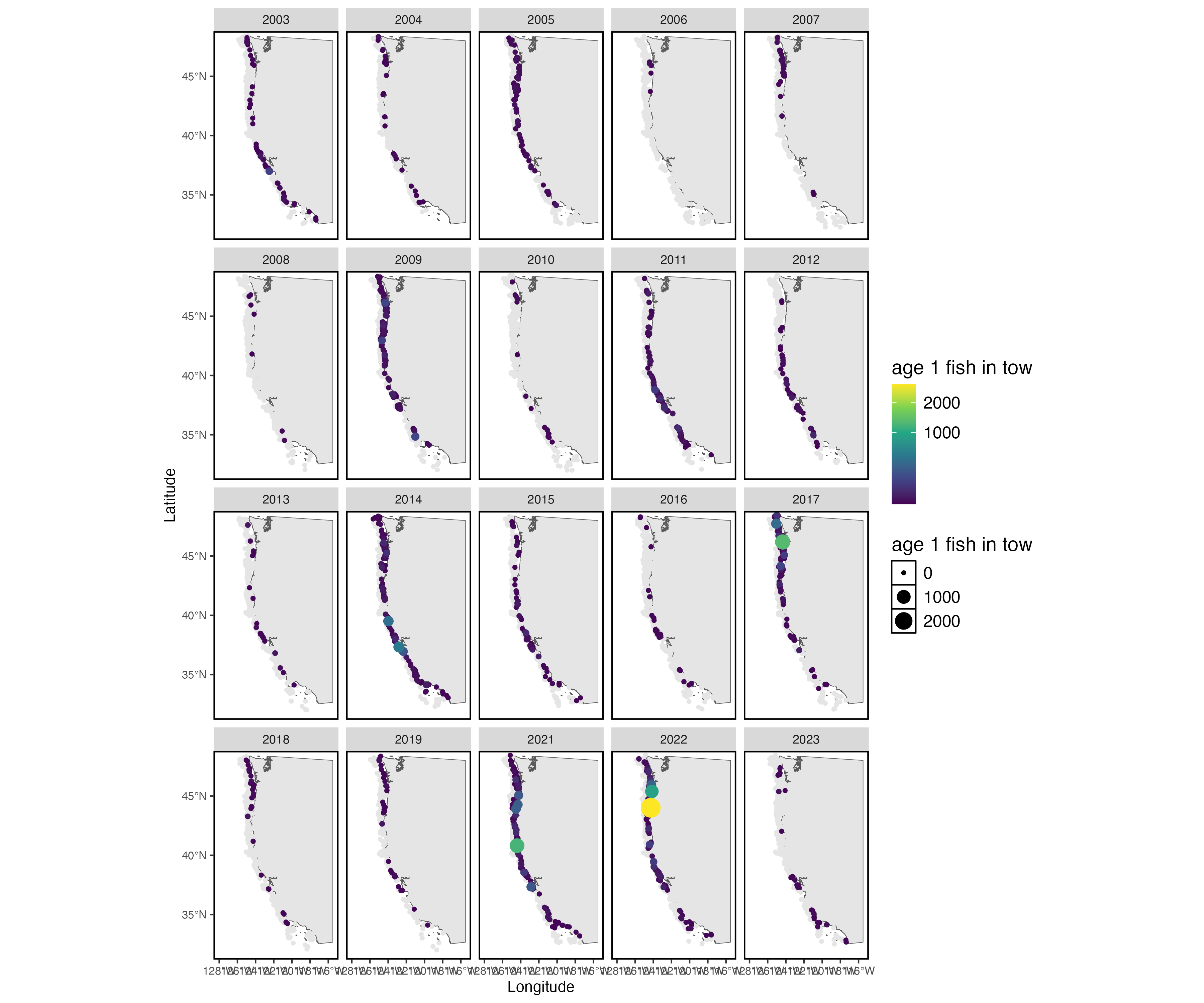
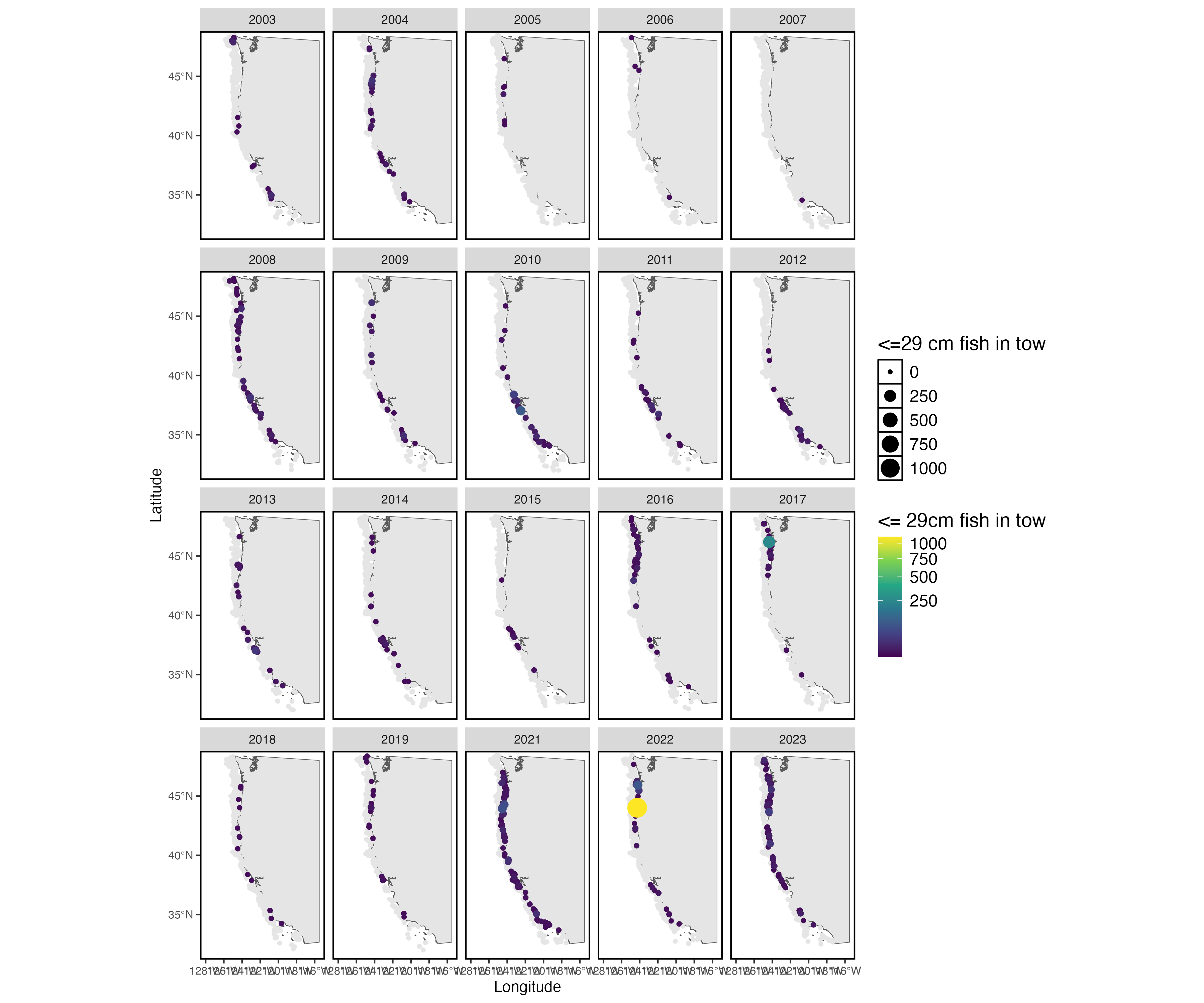
Below, I show age-0 and age-1 fish to show the distribution of recent recruits, and age-7+ fish for the distribution of potential spawners (age at 50% maturity was estimated to be 6.86 years in Head et al. 2014). I also show the length-based estimates for age-0 recruits (<=29 cm) and for spawners (>= 55cm, again based on the L50 estimated in Head et al. 2014).

Note that these age-0 and age-1 fish are included in the stock assessment, which means that they do inform the estimate of recruitment. The age-0 and age-1 fish could be used as either our estimates of recruitment, or be included as a predictor for recruitment (but note that this becomes problematic because they are already informing the estimate of recruitment).
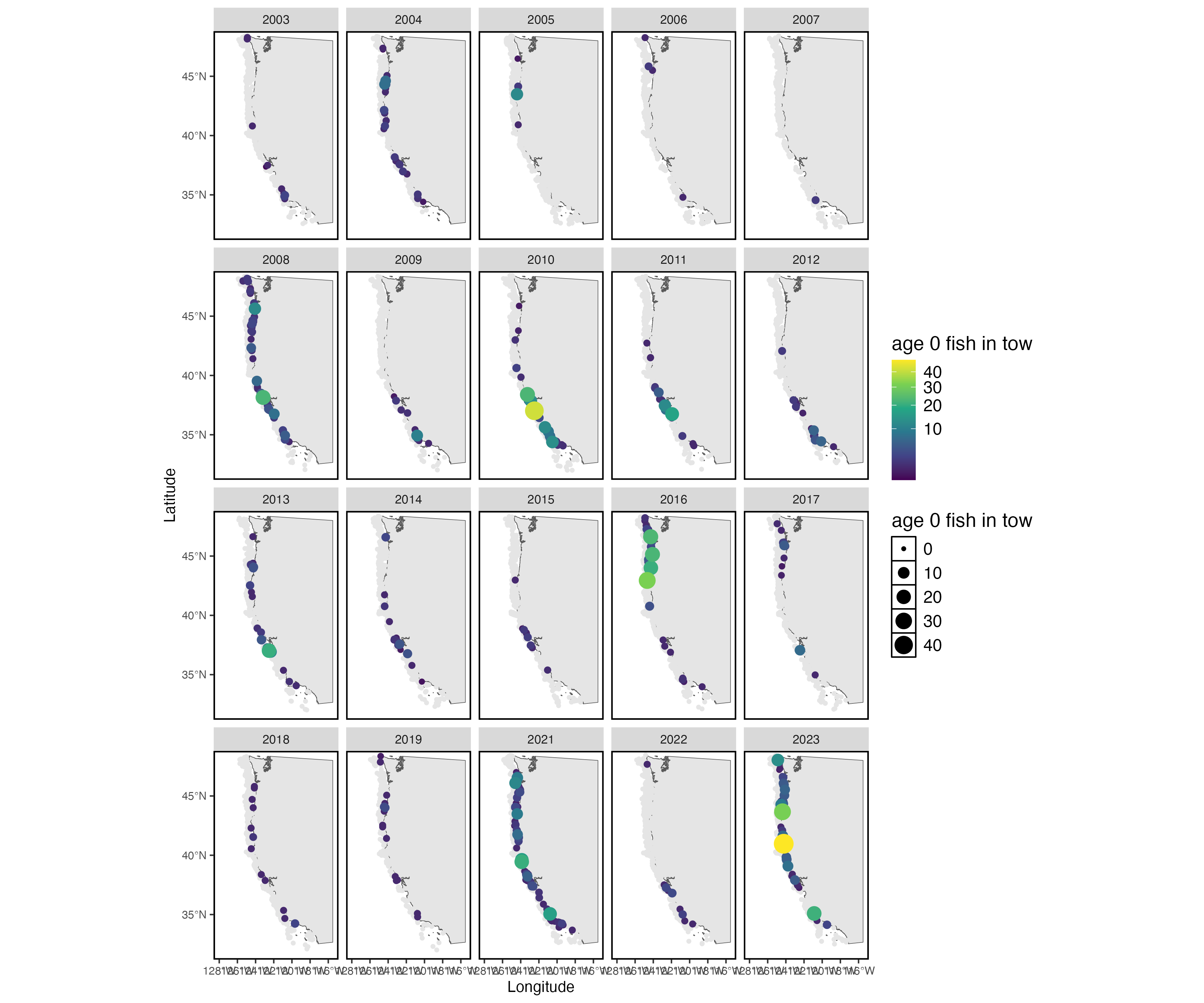
Age-0 Sablefish caught by the WCGBTS, based on the expansion of sampled age/length compositions to the full catch of each tow.

Age-1 Sablefish caught by the WCGBTS, based on the expansion of sampled age/length compositions to the full catch of each tow.


Sablefish <= 29 cm caught by the WCGBTS, based on the expansion of sampled age/length compositions to the full catch of each tow. This is the length cutoff generally accepted for age-0 Sablefish, although some years (2022) with exceptionally high juvenile Sablefish density show stunted growth as the likely result of density-dependence, meaning that this may not be reliable for 2022.


Recruitment deviations from the stock assessment vs. the total number of age-0 fish caught in the WCGBTS.


Recruitment deviations from the stock assessment vs. the total number of age-1 fish caught in the WCGBTS.


Sablefish >= 55 cm caught by the WCGBTS, based on the expansion of sampled age/length compositions to the full catch of each tow. 55 cm is the L50 for this species.